
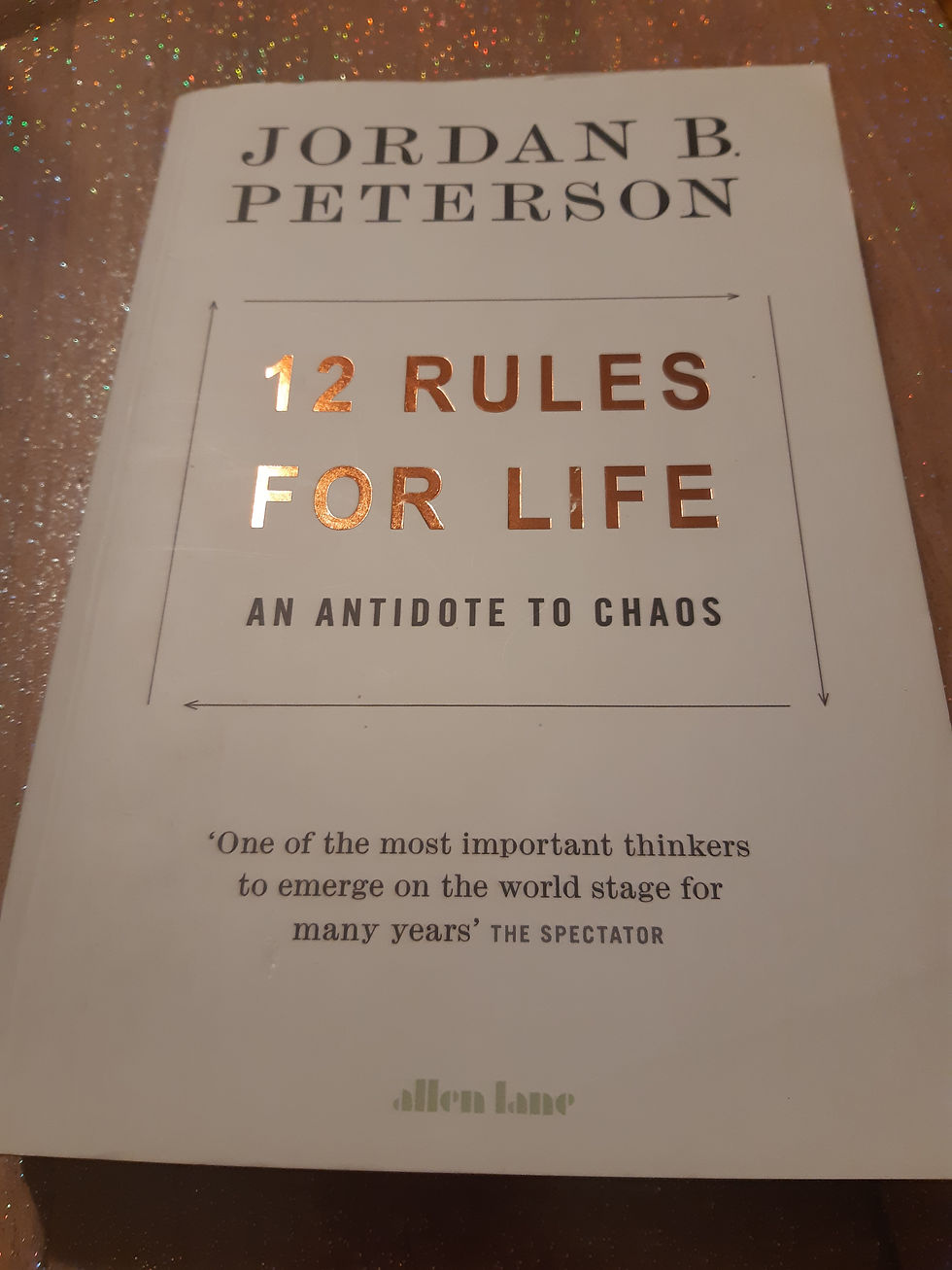
12 RULES FOR LIFE!
- Branko
- Jan 20, 2023
- 4 min read

Updated: Jan 20, 2023
The book 12 Rules for Life: An Antidote to Chaos is jam-packed with so much insight on the human psyche and the human condition that it is a roller-coaster ride from first page to last. It is not a typical ‘self-help’ or ‘life-coaching’ book by any means!
It intertwines religion, politics, evolution, mythology, psychology, politics, philosophy with references to such greats like Aristotle, Socrates, Dostoyevsky, Solzhenitsyn, Nietzsche, Jung and Freud just to name some. It digs at the deepest chambers of the human mind and offers astute advice on how to live a life worth living.
One of the central axioms of the book is the notion of treading on the precipice of order and chaos (the Taoist concept of yin and yang) and how everything in the universe is a dichotomy. Recognition of that makes life easier. Life is, after all, suffering and having a pragmatic and sincere approach is essential when dealing with such a challenging concept.

“Order and chaos are the yang and yin of the famous Taoist symbol: two serpents, head to tail. Order is the white, masculine serpent; Chaos, its black, feminine counterpart. The black dot in the white—and the white in the black—indicate the possibility of transformation: just when things seem secure, the unknown can loom, unexpectedly and large. Conversely, just when everything seems lost, new order can emerge from catastrophe and chaos. For the Taoists, meaning is to be found on the border between the ever-entwined pair. To walk that border is to stay on the path of life, the divine Way. And that’s much better than happiness.
It is possible to transcend slavish adherence to the group and its doctrines and, simultaneously, to avoid the pitfalls of its opposite extreme, nihilism. It is possible, instead, to find sufficient meaning in individual consciousness and experience. How could the world be freed from the terrible dilemma of conflict, on the one hand, and psychological and social dissolution, on the other? The answer was this: through the elevation and development of the individual, and through the willingness of everyone to shoulder the burden of Being and to take the heroic path.”
There are so many great anecdotes and references (he is a clinical psychologist) and Peterson has not only shown to be full of wisdom and knowledge, but also a great storyteller. There is a host of great points on how to have a meaningful relationship with your partner, children, parents, siblings. How speaking the truth and always striving for the truth is a kind of medicine and a healer of sorts. How bringing up children is not an easy task, but one worth undertaking. Overprotecting them and shielding them from the wicked world is basically the worst thing you can do to a child. When the time comes to face the cruel realities of life they will not be prepared, and it will eat them up. Not having a sincere and truthful relationship with your partner and sweeping things under the rug just makes the monster grow until it grows so big that it ends up eating you alive. The key to life is responsibility!
Having finished reading this book, I can say that it’s inspirational and thought-provoking, and it resonates in so many different ways. I feel at least a little wiser and knowledgeable. A big recommendation!
I’ll finish with the 12 rules and a few quotes.
1. Stand up straight with your shoulders back
2. Treat yourself like someone you are responsible for helping
3. Make friends with people who want the best for you
4. Compare yourself to who you were yesterday, not to who someone else is today
5. Do not let your children do anything that makes you dislike them
6. Set your house in perfect order before you criticize the world
7. Pursue what is meaningful (not what is expedient)
8. Tell the truth – or, at least, don't lie
9. Assume that the person you are listening to might know something you don't
10. Be precise in your speech
11. Do not bother children when they are skateboarding
12. Pet a cat when you encounter one on the street
“If you don't say what you think then you kill your unborn self.” “In the West, we have been withdrawing from our tradition-, religion- and even nation-centred cultures, partly to decrease the danger of group conflict. But we are increasingly falling prey to the desperation of meaninglessness, and that is no improvement at all.”
“Every bit of learning is a little death. Every bit of new information challenges a previous conception, forcing it to dissolve into chaos before it can be reborn as something better. Sometimes such deaths virtually destroy us.”
“We require routine and tradition. That’s order. Order can become excessive, and that’s not good, but chaos can swamp us, so we drown— and that is also not good. We need to stay on the straight and narrow path.”
“If a child has not been taught to behave properly by the age of four, it will forever be difficult for him or her to make friends.”
“To straddle that fundamental duality is to be balanced: to have one foot firmly planted in order and security, and the other in chaos, possibility, growth and adventure. When life suddenly reveals itself as intense, gripping and meaningful; when time passes and you’re so engrossed in what you’re doing you don’t notice—it is there and then that you are located precisely on the border between order and chaos.”
“It is necessary to be strong in the face of death, because death is intrinsic to life. It is for this reason that I tell my students: aim to be the person at your father’s funeral that everyone, in their grief and misery, can rely on. There’s a worthy and noble ambition: strength in the face of adversity.”
KEYWORDS/KEYPHRASES
-jam-packed: extremely crowded or full to capacity
-roller-coaster ride: An experience that involves many emotional highs and lows, or really good times alternating with really difficult times
-axiom: a statement that is taken to be true, to serve as a premise or starting point for further reasoning and arguments
-dichotomy: a difference between two completely opposite ideas or things
-nihilism: a viewpoint that traditional values and beliefs are unfounded, and that existence is senseless and useless
-to shoulder something (idiom): to accept the responsibility for something.
-to sweep something under the rug (idiom): to hide a problem or try to keep it secret instead of dealing with it
-to swamp someone: to affect someone in a major way, so that they are almost unable to deal with their feelings or with a particular situation
-intrinsic: belonging naturally; essential


Comments